Whether you've worn glasses since childhood or contacts for decades — modern refractive surgery can give you sharp, natural vision without any aids. We offer every proven option, and we'll help you discover which one your eyes are suited for.

Not every eye is suitable for LASIK — and that's not a problem. ICL and PRK exist precisely to serve eyes that LASIK cannot. The most important first step is a thorough suitability screening, after which we'll give you a clear, honest recommendation.
Each procedure works differently, suits different eye profiles, and delivers excellent outcomes in the right hands. Your surgeon will recommend the most appropriate option after your suitability screening.
ICL implantation is a surgical procedure performed under topical anaesthesia in our modular clean-room OT. Vision typically stabilises within days and is often dramatically sharper than anything glasses or contacts provided.
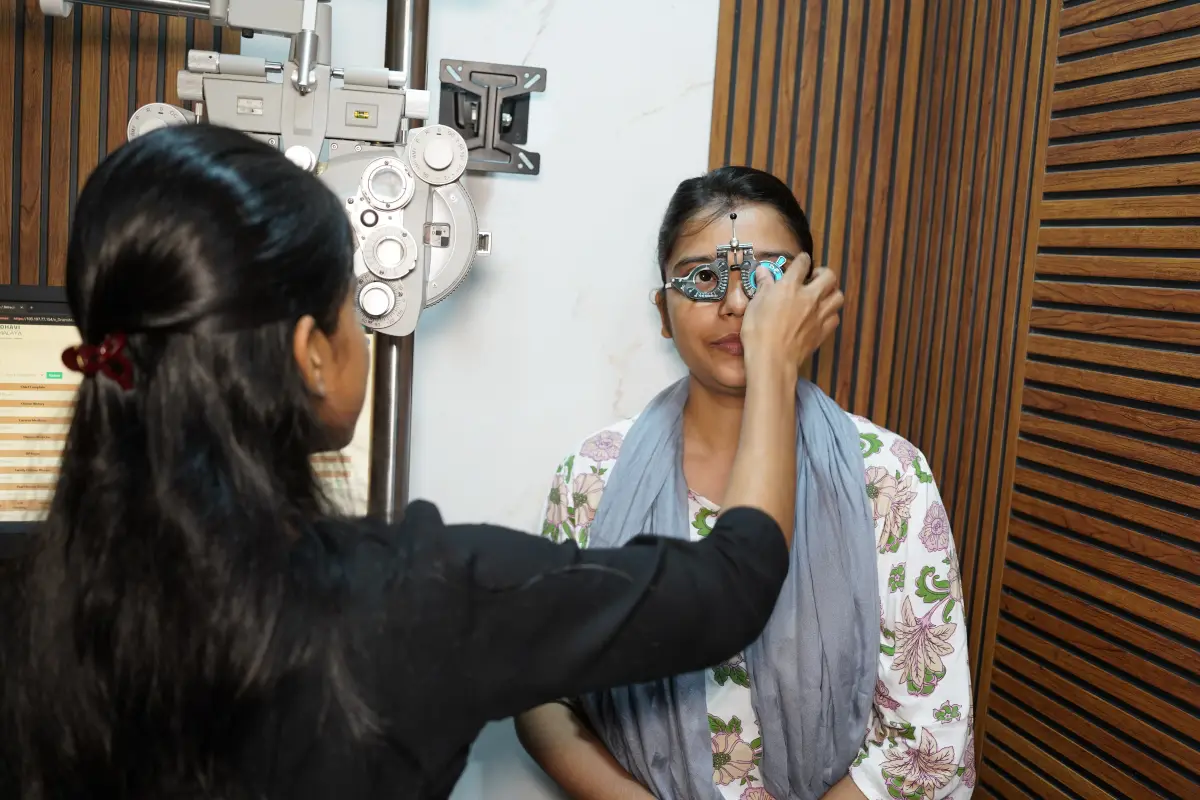
Our refractive screening is a comprehensive evaluation covering corneal shape, thickness, pupil size, tear film, and retinal health — giving us everything we need to tell you honestly whether surgery is right for you, and if so, which procedure.
Please note: You will need to remove soft contact lenses for 3 days (rigid/toric lenses for 3 weeks) before the screening appointment, as lenses change the corneal shape temporarily.
No. Anaesthetic eye drops completely numb the eye before the procedure. You may feel slight pressure for a few seconds during flap creation, but there is no pain. Most patients are surprised by how quick and comfortable the experience is.
LASIK removes corneal tissue using a laser to reshape the cornea. ICL implants an additional lens inside the eye without removing any tissue. ICL is preferred for high powers, thin corneas, and patients who want a reversible option. LASIK suits mild to moderate powers with adequate corneal thickness.
In well-screened patients with stable pre-operative refraction, regression is minimal. Most patients maintain excellent vision for many years. A small degree of regression can occur and can usually be addressed with an enhancement procedure if clinically appropriate.
High powers typically require more corneal tissue removal, which may not be safe if your cornea is not thick enough. In these cases, ICL is the preferred solution — implanting a custom lens inside the eye achieves excellent results even for powers of –10 to –20.
Most patients return to desk work and screen use within 1–2 days after LASIK. Contact sport and swimming should be avoided for 4 weeks. After PRK, visual recovery takes 1–2 weeks, though office work is often possible after 5–7 days.
Not at all. LASIK and ICL are suitable through your late 27s and even early 40s, provided your power is stable and corneas are healthy. However, your surgeon will factor in that reading vision naturally changes in the mid-40s, which may influence which option and which power target is recommended.
Our refractive suitability screening is comprehensive, honest, and judgment-free. We'll tell you exactly what your eyes are suited for — LASIK, ICL, PRK, or none of the above — and explain every option clearly.