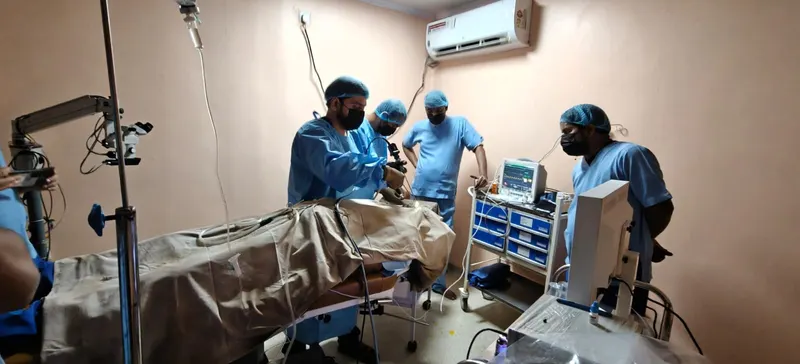
Oculoplasty is the subspecialty that cares for everything surrounding your eye — the eyelids, tear drainage system, and eye socket. From a persistent watering eye to a drooping lid affecting your vision, we now offer the full spectrum including Endoscopic DCR — the most advanced lacrimal surgery available.

Madhavi Netralaya is proud to announce Endoscopic Dacryocystorhinostomy — an advanced, minimally invasive solution for patients suffering from persistent watering of the eyes due to blocked tear ducts. The surgery is performed entirely through the nasal passage, leaving zero external scar on the face.

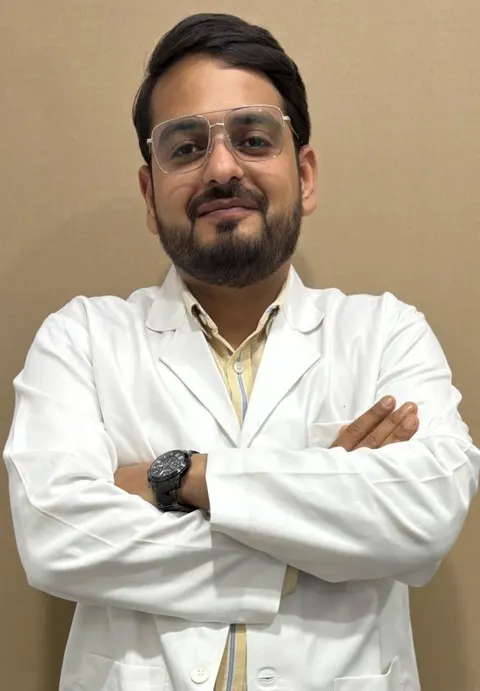
This specialised service is offered through a clinical collaboration with Dr. Vibhor Malhotra — bringing Delhi-level ENT endoscopic surgical expertise directly to our patients in Ara.

Dr. Vibhor Malhotra is a highly experienced Consultant ENT Surgeon currently practising at Maharaja Agrasen Hospital, New Delhi. He brings exceptional expertise in endoscopic procedures to Madhavi Netralaya's Endoscopic DCR programme — a procedure that sits at the precise intersection of ophthalmology and ENT, requiring specialised endoscopic skill to navigate the nasal anatomy and create a precise stoma at the lacrimal sac.
His clinical background spans some of India's most prestigious institutions, and his training in advanced hearing implant surgeries reflects the same level of precision and technical command required for high-quality endoscopic lacrimal surgery.
Persistent epiphora (watering of the eye) caused by a blocked nasolacrimal duct is one of the most frustrating conditions in ophthalmology. The tears cannot drain, overflow onto the cheek, cause recurrent infections of the lacrimal sac, and create social embarrassment — yet the condition is entirely fixable with the right surgery.
Dacryocystorhinostomy (DCR) creates a new drainage pathway directly from the lacrimal sac into the nasal cavity, bypassing the blocked nasolacrimal duct entirely. Tears then drain naturally and the eye stops watering.
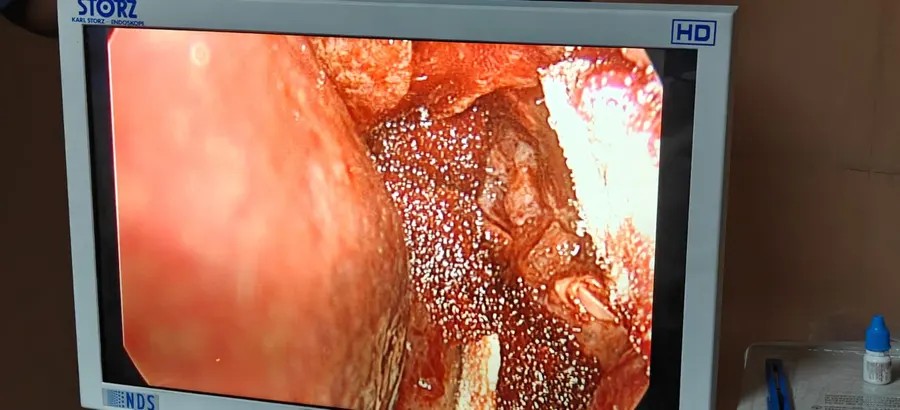
The traditional approach (External DCR) requires a skin incision on the side of the nose. Endoscopic DCR eliminates this entirely — the entire operation is performed with an endoscope inserted through the nostril. The result is identical drainage outcome, with zero external scar.
In addition to our signature Endoscopic DCR programme, we offer the full range of oculoplasty and lacrimal procedures at Madhavi Netralaya.
Complete lacrimal surgical programme: sac syringing with antibiotics for assessment, conventional External DCR, DCR with silicone intubation for difficult cases, and our flagship Endoscopic DCR using the Karl Storz system — performed in collaboration with Dr. Vibhor Malhotra.
A drooping upper eyelid can obstruct vision, cause compensatory head tilt, and produce a tired or asymmetric appearance. We assess levator muscle function and recommend the most appropriate surgical approach — suture sling for mild ptosis, silicone sling for poor levator function.
Inward-turning lids (entropion) cause lashes to rub the eye surface, producing chronic irritation, watering, and corneal damage. Outward-turning lids (ectropion) cause exposure, dryness, and tearing. Both are corrected with precise lid-tightening or repositioning surgery.
A chalazion is a chronic granulomatous inflammation of a meibomian gland in the eyelid, presenting as a painless lump. When it does not resolve with warm compresses, incision and curettage under local anaesthesia removes it completely in a minor procedure.
Benign and suspicious lesions on the eyelid are excised with careful reconstruction to preserve normal lid function and cosmetic appearance. Minor lid lacerations are repaired under local anaesthetic. Major lid trauma with tissue loss is repaired with lid-sharing or flap techniques.
For patients with aqueous-deficient dry eye, punctal plugs conserve natural tears by blocking the drainage openings. Temporary dissolving plugs, permanent silicone plugs, and punctal cautery (permanent closure) are all available depending on severity and preference.
| Procedure | Details |
|---|---|
⭐ Endoscopic DCR (Karl Storz) | Nasal route, no external incision, no scar. Performed in collaboration with Dr. Vibhor Malhotra, Consultant ENT Surgeon. Karl Storz high-definition endoscopic system. |
DCT (Dacryocystectomy) | Removal of the lacrimal sac when DCR is not suitable. Eliminates recurrent dacryocystitis. |
DCR (Conventional External) | Traditional skin incision approach with creation of new ostium. Long-established technique with excellent outcomes. |
DCR with Intubation | Silicone tube intubation of the lacrimal system during DCR for cases with narrow canaliculi or revision surgery. |
Sac Syringing with Antibiotics | Diagnostic and therapeutic irrigation of the lacrimal system. One or both sides. First-line assessment for watering eyes. |
Punctal Plug — Temporary (Single Punctum) | Dissolvable plug in one tear drainage opening of a single eye. For trial of punctal occlusion. |
Punctal Plug — Temporary (Both Puncta) | Dissolvable plugs in both upper and lower puncta of a single eye for comprehensive tear conservation. |
Punctal Plug with Antibiotic Irrigation | Combined punctal plug insertion with antibiotic lavage. Both puncta of a single eye. |
Punctal Plug — Permanent (Dry Eye) | Silicone plug permanently placed for aqueous-deficient dry eye. Long-term tear conservation. |
Punctal Cautery | Permanent cauterisation of the punctal opening for severe dry eye where plugs are insufficient. |
Ptosis Repair — Suture Sling | For ptosis with fair levator function. Frontalis suspension using prolene suture. |
Ptosis Repair — Silicone Sling | For ptosis with poor levator function. Silicone rod suspension to frontalis muscle. |
Entropion Repair | Lid-tightening procedure to correct inward-turning eyelid margin. |
Ectropion Repair | Lid-tightening or repositioning procedure to correct outward-turning eyelid margin. |
Chalazion I&C | Incision and curettage of eyelid meibomian gland cyst under local anaesthesia. |
Lid Mass Removal | Excision of benign or suspicious eyelid lesion with primary closure or reconstruction. |
Lid Repair — Minor | Repair of minor eyelid laceration not involving the lid margin or lacrimal system. |
Lid Repair — Major | Repair of major lid trauma including lid margin, canaliculus, or significant tissue loss. |
Evisceration | Removal of intraocular contents preserving the scleral shell. For blind, painful eye. |
Enucleation | Removal of the entire globe. For blind painful eye, intraocular tumour, or trauma. |
Persistent watering from a blocked nasolacrimal duct does not resolve on its own and cannot be cured with eye drops. A clinical examination and syringing test will confirm whether your duct is blocked. If it is, DCR — conventional or endoscopic — is the definitive surgical treatment with high success rates.
Both create the same new drainage pathway from the lacrimal sac to the nasal cavity. Conventional External DCR requires a skin incision on the side of the nose, which heals as a scar. Endoscopic DCR performs the entire surgery through the nostril with a camera — leaving no external scar whatsoever. Recovery is typically faster and more comfortable.
The procedure is performed under general or local anaesthesia. Postoperatively, patients may experience mild nasal discomfort or congestion for a few days, but significant pain is uncommon. Most patients return to normal activities within a few days of the surgery.
Endoscopic DCR requires navigating the nasal anatomy precisely to create the drainage opening. ENT surgeons are specifically trained in endoscopic nasal surgery — Dr. Vibhor Malhotra's expertise in this area means every patient benefits from two specialists working together: an ophthalmologist managing the lacrimal anatomy from above, and an ENT surgeon managing the nasal approach with the Karl Storz endoscope.
If the drooping is mild and doesn't affect vision or cause brow ache or head tilt, surgery is optional. However, even cosmetic ptosis can have functional benefits — improved visual field, reduction of compensatory eyebrow raising, and better binocular vision in downgaze. We assess the degree of ptosis and discuss your priorities honestly before recommending anything.
A lump present for more than 4–6 weeks that has not responded to warm compresses is almost certainly a chalazion (meibomian gland cyst). While not dangerous, it can affect vision if large, cause cosmetic concern, and become infected. A simple Incision and Curettage procedure under local anaesthesia resolves it completely in most cases. Recurrent chalazia warrant further evaluation.
Patients suffering from persistent eye watering due to blocked tear ducts can now access Endoscopic DCR — the most advanced lacrimal surgery — right here in Ara. No travel to a metro city. No external scar. Performed with the Karl Storz endoscopic system by Dr. Vibhor Malhotra.
Or call: 1800-571-9090 (24/7)