✦ Refractive Surgery

Glasses off. Forever.See the World on
Your Own Terms.

Whether you've worn glasses since childhood or contacts for decades — modern refractive surgery can give you sharp, natural vision without any aids. We offer every proven option, and we'll help you discover which one your eyes are suited for.

ICL Implantable LensesWavefront-Guided LASIKPRKToric ICL for astigmatism
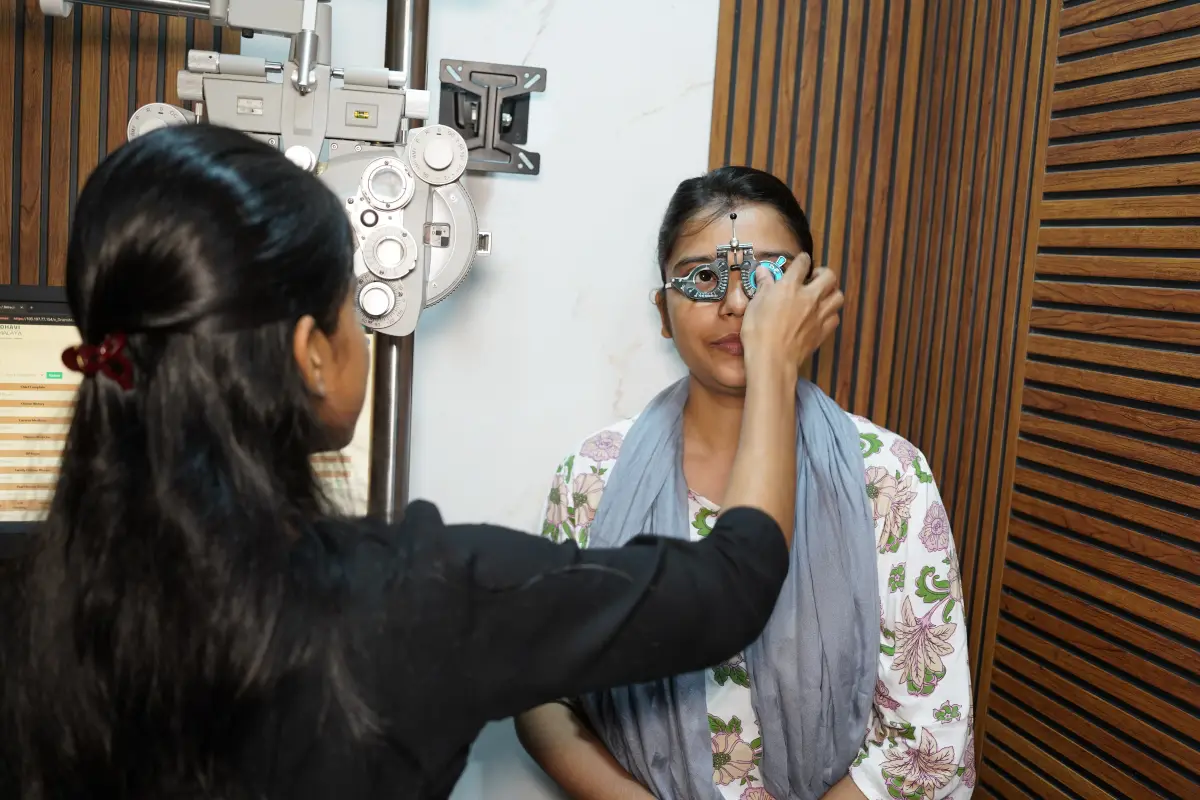
Myopia clinic — phoropter and refraction suite
🔬 Wavefront-Guided LASIK · Implantable Collamer Lens (ICL) · PRK · Toric ICL
ICL for High PowersWavefront-Guided LASIKThin Cornea Options AvailableToric ICL for AstigmatismPRK Surface AblationSame-Day Suitability TestICL for High PowersWavefront-Guided LASIKThin Cornea Options AvailableToric ICL for AstigmatismPRK Surface AblationSame-Day Suitability Test
Am I a Candidate?

Every Eye Is Different. We'll Tell You Exactly
What's Possible for Yours.

Not every eye is suitable for LASIK — and that's not a problem. ICL and PRK exist precisely to serve eyes that LASIK cannot. The most important first step is a thorough suitability screening, after which we'll give you a clear, honest recommendation.

✓ You may be a good candidate if:
  • Age 18–40 with stable power for at least 1 year
  • Near-sightedness (myopia), far-sightedness, or astigmatism
  • Adequate corneal thickness (for LASIK/PRK)
  • High power (–8 to –20) may be suited for ICL instead of LASIK
  • Thin corneas that make LASIK risky → ICL or PRK are alternatives
⚠ Surgery may not be suitable if:
  • Power is still changing (unstable refraction)
  • Pregnancy or breastfeeding (hormonal effects on cornea)
  • Keratoconus or ectatic corneal disease (CXL may be needed first)
  • Severe dry eye disease (requires treatment first)
  • Certain autoimmune or connective tissue conditions
Surgical Options

Three Proven Pathways to
Glasses-Free Vision

Each procedure works differently, suits different eye profiles, and delivers excellent outcomes in the right hands. Your surgeon will recommend the most appropriate option after your suitability screening.

⭐ Best for High Powers & Thin Corneas
ICL — Implantable Collamer Lens
A micro-thin lens implanted inside the eye — in front of the natural lens — without removing any corneal tissue. The only reversible refractive procedure.
Refractive surgery consultation — phoropter and refraction suite
"Unlike LASIK, ICL adds a lens without removing any corneal tissue — making it ideal for high prescriptions and thin corneas where LASIK is not safe."
  • Suitable for powers from –3 to –20 diopters
  • Works beautifully for thin corneas unsuitable for LASIK
  • Toric ICL corrects astigmatism simultaneously
  • Excellent night vision quality — no halos or glare issues
  • Completely reversible — the lens can be removed if needed
  • Procedure takes approximately 20–27 minutes per eye
✓ Ideal for: High myopia (–6 and above) · Thin corneas · Patients seeking reversibility · High astigmatism

ICL implantation is a surgical procedure performed under topical anaesthesia in our modular clean-room OT. Vision typically stabilises within days and is often dramatically sharper than anything glasses or contacts provided.

Most Common
Wavefront-Guided LASIK
A precisely guided excimer laser reshapes the cornea to correct your refractive error. The wavefront map personalises treatment to your unique corneal topography.
  • Custom treatment mapped to your unique corneal shape
  • Procedure takes approximately 10–15 minutes per eye
  • Vision typically clear by the next morning
  • Suitable for mild to moderate myopia, hyperopia, and astigmatism
  • Requires adequate corneal thickness for safe treatment
✓ Best for: Moderate myopia up to –8 · Adequate corneal thickness · Active lifestyle (sport, work)
Surface Ablation
PRK — Photo-Refractive Keratectomy
The original laser vision correction technique. No flap is created — the surface epithelium is removed and the laser applied directly to the corneal surface.
  • Ideal when cornea is too thin for LASIK
  • No flap — eliminates flap-related complications entirely
  • Visual recovery takes 1–2 weeks (slower than LASIK)
  • Long-term outcomes equivalent to LASIK
  • Preferred for contact sports or occupations with eye injury risk
✓ Best for: Thin corneas · Contact sports athletes · Mild to moderate myopia
The Suitability Screening

One Thorough Visit Tells You
Exactly What's Possible

Our refractive screening is a comprehensive evaluation covering corneal shape, thickness, pupil size, tear film, and retinal health — giving us everything we need to tell you honestly whether surgery is right for you, and if so, which procedure.

Please note: You will need to remove soft contact lenses for 3 days (rigid/toric lenses for 3 weeks) before the screening appointment, as lenses change the corneal shape temporarily.

WHAT YOUR SUITABILITY SCREENING INCLUDES
1
Corneal Topography & Aberrometry
Maps the exact shape and power of your cornea — ruling out keratoconus
2
Optical Pachymetry (Corneal Thickness)
Determines if enough tissue remains after laser treatment for safe LASIK
3
Pupil Diameter Measurement
Large pupils in dim light can cause halos post-LASIK — assessed carefully
4
Dry Eye Screening (IDRA)
Active dry eye must be treated before surgery to ensure outcomes
5
Dilated Retina Examination
High myopia increases risk of retinal tears — screened before surgery
6
Surgeon Consultation
Dr. Nilesh Kumar reviews all data and gives you a clear, honest recommendation
Common Questions

What Refractive Surgery Patients Ask

Is LASIK painful?

No. Anaesthetic eye drops completely numb the eye before the procedure. You may feel slight pressure for a few seconds during flap creation, but there is no pain. Most patients are surprised by how quick and comfortable the experience is.

What is the difference between LASIK and ICL?

LASIK removes corneal tissue using a laser to reshape the cornea. ICL implants an additional lens inside the eye without removing any tissue. ICL is preferred for high powers, thin corneas, and patients who want a reversible option. LASIK suits mild to moderate powers with adequate corneal thickness.

Will my power come back after surgery?

In well-screened patients with stable pre-operative refraction, regression is minimal. Most patients maintain excellent vision for many years. A small degree of regression can occur and can usually be addressed with an enhancement procedure if clinically appropriate.

Can I get LASIK if my power is very high (more than –8)?

High powers typically require more corneal tissue removal, which may not be safe if your cornea is not thick enough. In these cases, ICL is the preferred solution — implanting a custom lens inside the eye achieves excellent results even for powers of –10 to –20.

How long before I can return to work after LASIK?

Most patients return to desk work and screen use within 1–2 days after LASIK. Contact sport and swimming should be avoided for 4 weeks. After PRK, visual recovery takes 1–2 weeks, though office work is often possible after 5–7 days.

I'm 35 — is it too late for LASIK?

Not at all. LASIK and ICL are suitable through your late 27s and even early 40s, provided your power is stable and corneas are healthy. However, your surgeon will factor in that reading vision naturally changes in the mid-40s, which may influence which option and which power target is recommended.

Take the First Step

Find Out If You're a Candidate.
It Takes One Visit.

Our refractive suitability screening is comprehensive, honest, and judgment-free. We'll tell you exactly what your eyes are suited for — LASIK, ICL, PRK, or none of the above — and explain every option clearly.